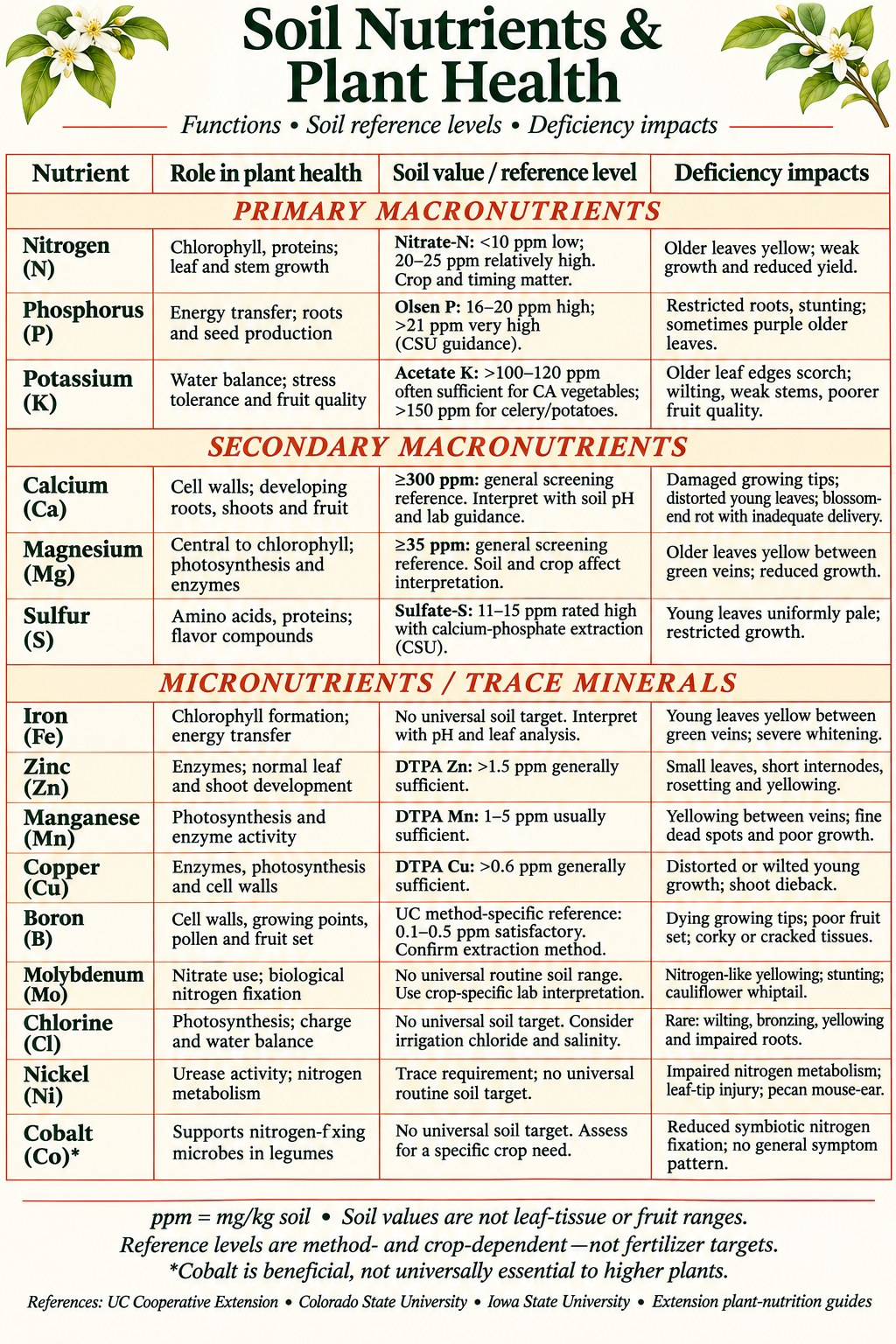
Soil Nutrients & Plant Health
In short: plants need 15 or so nutrients from the soil to grow strong and fight off pests and disease.
Below is what each one does, a soil reference level, and the signs of a shortage. Reference levels depend on the lab
method and the crop, so they're a guide, not fertilizer targets. A soil test is the best place to start.
Primary Macronutrients
Needed in the largest amounts. These are the N-P-K numbers on a fertilizer bag.
N
Nitrogen
- Role in plant health
- Chlorophyll, proteins; leaf and stem growth.
- Soil reference level
- Nitrate-N: <10 ppm low; 20–25 ppm relatively high. Crop and timing matter.
- Deficiency signs
- Older leaves yellow; weak growth and reduced yield.
P
Phosphorus
- Role in plant health
- Energy transfer; roots and seed production.
- Soil reference level
- Olsen P: 16–20 ppm high; >21 ppm very high (CSU guidance).
- Deficiency signs
- Restricted roots, stunting; sometimes purple older leaves.
K
Potassium
- Role in plant health
- Water balance; stress tolerance and fruit quality.
- Soil reference level
- Acetate K: >100–120 ppm often sufficient for CA vegetables; >150 ppm for celery/potatoes.
- Deficiency signs
- Older leaf edges scorch; wilting, weak stems, poorer fruit quality.
Secondary Macronutrients
Needed in moderate amounts, and just as essential.
Ca
Calcium
- Role in plant health
- Cell walls; developing roots, shoots and fruit.
- Soil reference level
- ≥300 ppm: general screening reference. Interpret with soil pH and lab guidance.
- Deficiency signs
- Damaged growing tips; distorted young leaves; blossom-end rot with inadequate delivery.
Mg
Magnesium
- Role in plant health
- Central to chlorophyll; photosynthesis and enzymes.
- Soil reference level
- ≥35 ppm: general screening reference. Soil and crop affect interpretation.
- Deficiency signs
- Older leaves yellow between green veins; reduced growth.
S
Sulfur
- Role in plant health
- Amino acids, proteins; flavor compounds.
- Soil reference level
- Sulfate-S: 11–15 ppm rated high with calcium-phosphate extraction (CSU).
- Deficiency signs
- Young leaves uniformly pale; restricted growth.
Micronutrients / Trace Minerals
Needed in tiny amounts, but a shortage can still stop a plant in its tracks.
Fe
Iron
- Role in plant health
- Chlorophyll formation; energy transfer.
- Soil reference level
- No universal soil target. Interpret with pH and leaf analysis.
- Deficiency signs
- Young leaves yellow between green veins; severe whitening.
Zn
Zinc
- Role in plant health
- Enzymes; normal leaf and shoot development.
- Soil reference level
- DTPA Zn: >1.5 ppm generally sufficient.
- Deficiency signs
- Small leaves, short internodes, rosetting and yellowing.
Mn
Manganese
- Role in plant health
- Photosynthesis and enzyme activity.
- Soil reference level
- DTPA Mn: 1–5 ppm usually sufficient.
- Deficiency signs
- Yellowing between veins; fine dead spots and poor growth.
Cu
Copper
- Role in plant health
- Enzymes, photosynthesis and cell walls.
- Soil reference level
- DTPA Cu: >0.6 ppm generally sufficient.
- Deficiency signs
- Distorted or wilted young growth; shoot dieback.
B
Boron
- Role in plant health
- Cell walls, growing points, pollen and fruit set.
- Soil reference level
- UC method-specific reference: 0.1–0.5 ppm satisfactory. Confirm extraction method.
- Deficiency signs
- Dying growing tips; poor fruit set; corky or cracked tissues.
Mo
Molybdenum
- Role in plant health
- Nitrate use; biological nitrogen fixation.
- Soil reference level
- No universal routine soil range. Use crop-specific lab interpretation.
- Deficiency signs
- Nitrogen-like yellowing; stunting; cauliflower whiptail.
Cl
Chlorine
- Role in plant health
- Photosynthesis; charge and water balance.
- Soil reference level
- No universal soil target. Consider irrigation chloride and salinity.
- Deficiency signs
- Rare: wilting, bronzing, yellowing and impaired roots.
Ni
Nickel
- Role in plant health
- Urease activity; nitrogen metabolism.
- Soil reference level
- Trace requirement; no universal routine soil target.
- Deficiency signs
- Impaired nitrogen metabolism; leaf-tip injury; pecan mouse-ear.
Co
Cobalt*
- Role in plant health
- Supports nitrogen-fixing microbes in legumes.
- Soil reference level
- No universal soil target. Assess for a specific crop need.
- Deficiency signs
- Reduced symbiotic nitrogen fixation; no general symptom pattern.
- ppm = mg/kg soil.
- Soil values are not leaf-tissue or fruit ranges.
- Reference levels are method- and crop-dependent, not fertilizer targets.
- *Cobalt is beneficial, not universally essential to higher plants.
References: UC Cooperative Extension • Colorado State University • Iowa State University • Extension plant-nutrition guides
How WormTRAP can help
Our Soil & Water Testing shows exactly which nutrients your soil has and which it's missing, and Microscopic Analysis shows the soil life that makes those nutrients available to roots. From there, we build a plan using worm castings and worm tea.